Tracking Bettor Volumes and Their Effects on Gridiron Spread Adjustments
Written by Felix Schmid · Oct 29, 2026

Tracking Bettor Volumes and Their Effects on Gridiron Spread Adjustments
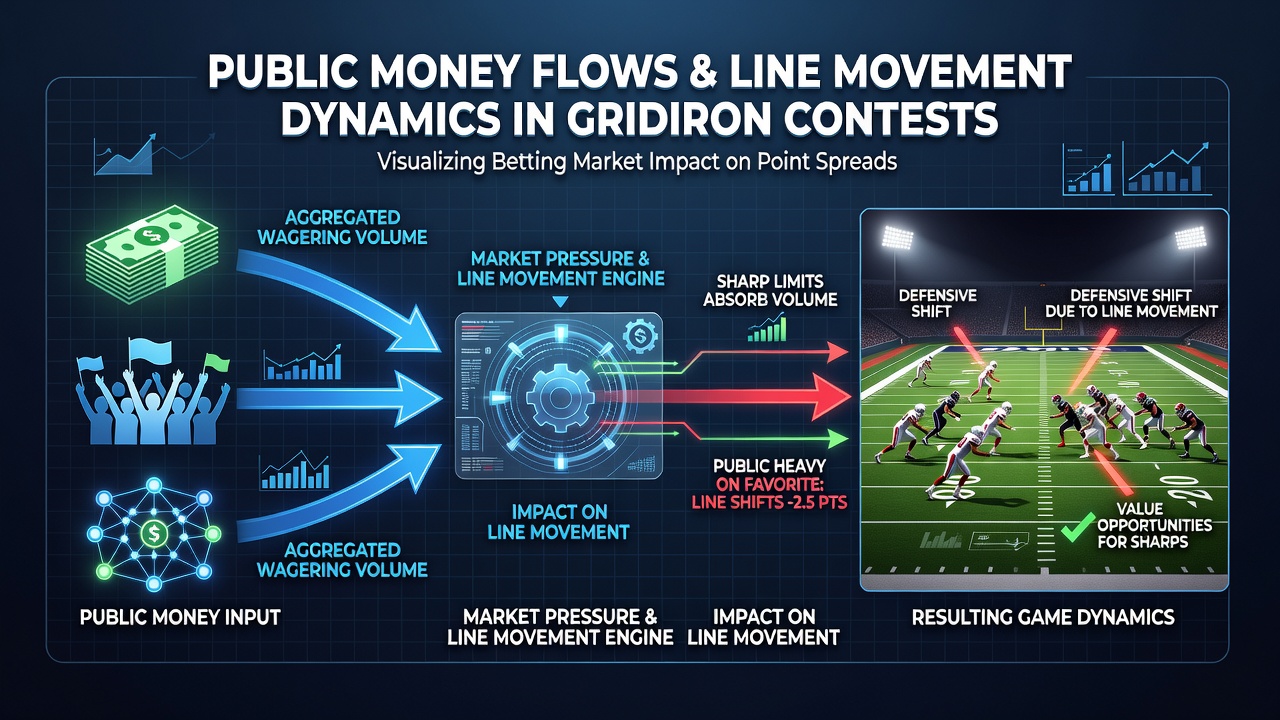
Public money flows represent the aggregate wagers placed by recreational bettors on NFL contests, and these volumes often trigger measurable shifts in point spreads and totals as sportsbooks respond to liability exposure. Data from recent seasons shows that when public betting exceeds 70 percent on one side of a matchup, oddsmakers frequently adjust lines by half a point or more to balance action, according to figures compiled by the American Gaming Association. Such adjustments occur because operators seek to limit risk rather than predict outcomes, and the pattern repeats across regular season weeks when fan interest spikes around high-profile teams. Observers note that line movement typically accelerates in the 24 to 48 hours before kickoff, when public volume peaks through mobile platforms and retail locations. In October 2026, early season games involving division leaders demonstrated this effect as spreads moved from the opening number within minutes of heavy ticket activity being reported. Researchers at the UNLV Center for Gaming Research have documented similar patterns across multiple years, finding that public-driven moves often reverse when sharp money enters later in the week and pushes the line back toward its original value.Mechanisms Behind Line Shifts
Sportsbooks monitor real-time betting percentages and dollar amounts to decide when a line requires adjustment, and public money plays the primary role in initiating those changes because it arrives in larger, less coordinated waves than professional wagers. When recreational bettors pile onto favorites, for instance, the spread widens to discourage additional action on that side while encouraging underdogs, and this dynamic appears consistently in both prime-time and afternoon windows. Industry reports indicate that totals markets follow a comparable path, with over bets from the public prompting totals to rise as books protect against overspending on scoring props.
Timing matters because early lines reflect limited information, whereas midweek adjustments incorporate injury news, weather updates, and practice reports alongside the public money surge. One documented case from the 2025 season involved a Thursday night contest where the spread moved three points after public tickets exceeded 80 percent on the home team, yet the line stabilized once professional syndicates countered with opposing wagers. Such sequences illustrate how public flows set the initial direction while later money determines the final resting point before kickoff.
Regional and Market Variations
Markets in states with mature sports betting regulations display distinct responses to public volume compared with newer jurisdictions, and data from the Ontario Lottery and Gaming Corporation reveals that Canadian operators adjust lines at different thresholds than their U.S. counterparts due to varying tax structures and bettor demographics. In both regions, however, the core principle remains identical: concentrated public action on one outcome forces a response to maintain balanced books. Studies from the University of Nevada, Las Vegas further confirm that these adjustments occur more rapidly in high-handle weeks such as those surrounding rivalry games or playoff implications.
Sharp bettors monitor public percentages through third-party services and often wait for the line to move before placing opposing wagers, creating a secondary wave that can produce additional movement or stabilization. This interplay between public initiation and professional correction appears in nearly every NFL week, with October 2026 examples showing multiple instances where early public leans on overs were later countered by sharp unders after totals climbed. The resulting line history provides analysts with a record of how volume alone can alter market prices independent of fundamental changes in team strength or game conditions.
Data Patterns Across Seasons
Longitudinal data indicates that public money exerts greater influence on totals than on sides in certain matchups, particularly when weather or pace factors remain uncertain until game day. Across the 2024 through 2026 seasons, totals in outdoor stadiums moved an average of 1.2 points more frequently following public over bets than comparable indoor contests, according to aggregated handle reports. These shifts occur because recreational bettors tend to favor overs in high-scoring environments, prompting books to raise numbers and attract opposing action from more disciplined participants.
Division games and interconference matchups produce different volume profiles, with public interest often higher when star players or popular franchises are involved. Observers tracking these patterns note that the magnitude of line movement correlates directly with the percentage of tickets rather than total dollars in many cases, because sportsbooks weigh the number of individual wagers when assessing liability distribution. This distinction helps explain why a game with widespread public support on one side can experience larger adjustments even when the dollar handle remains moderate compared with other contests.
Conclusion
Public money flows continue to serve as the primary catalyst for line movement in gridiron betting markets, while professional action provides the counterbalance that determines final prices. Records from regulatory bodies and academic centers demonstrate consistent patterns across jurisdictions and seasons, showing that volume thresholds trigger adjustments regardless of external variables. These dynamics remain central to understanding how NFL spreads and totals evolve from opening numbers through kickoff each week.