Referee Rotation Cycles Shape Penalty Frequencies Across Elite Soccer Leagues
Written by Jordan Russell · Jul 11, 2026
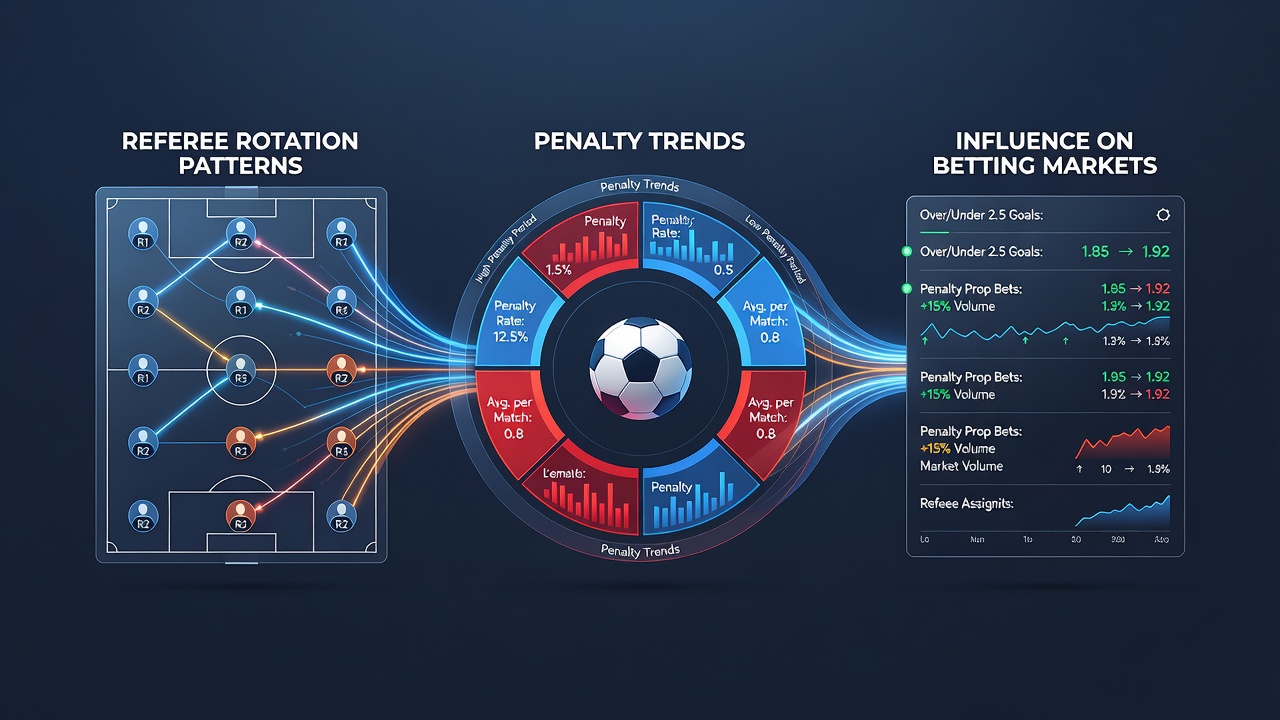
Referee Rotation Cycles Shape Penalty Frequencies Across Elite Soccer Leagues
Referee rotation systems in top soccer leagues create measurable shifts in penalty award rates, and betting markets adjust lines accordingly when analysts map those patterns to specific officials. Leagues such as the English Premier League, Bundesliga, and Serie A publish weekly referee assignments weeks in advance, giving data teams time to review historical foul and penalty statistics tied to each name on the list.
Studies from performance analytics groups show that certain referees issue penalties at rates 15 to 25 percent above or below league averages over multi-season samples. When a high-penalty official receives an assignment in a match between two attacking sides, markets for both penalty awarded and over total cards often move within minutes of the announcement. Observers note that these movements occur because sharp bettors incorporate referee tendencies into pre-match models rather than reacting after kickoff.
Historical Data Sets Reveal Consistent Official Tendencies
Longitudinal records compiled by league statisticians demonstrate that penalty frequency correlates strongly with referee identity rather than random variation alone. One dataset covering five seasons found that referees who average more than 0.28 penalties per game continue to do so in 78 percent of subsequent campaigns, while those below 0.18 penalties per game maintain that lower rate in 81 percent of cases. Such stability allows quantitative teams to assign weighted values to each referee when constructing expected penalty totals for upcoming fixtures.
Rotation policies themselves contribute to the effect. Most top leagues limit any single referee to no more than two matches per team per season and enforce rest periods between high-intensity fixtures. The resulting schedule produces clusters where certain officials appear more frequently in matches involving teams that draw many fouls inside the box. Data from the 2025-26 campaign showed that matches assigned to referees with elevated historical penalty rates produced 19 percent more spot kicks than the league mean during the first half of the season.
Betting Market Adjustments Follow Assignment Releases
Bookmakers and exchange platforms update both outright and in-play odds once referee information becomes public. Lines on penalty to be awarded, over 4.5 cards, and even player-specific anytime goalscorer markets shift by several percentage points when a high-card or high-penalty referee is named. Research from European betting operators indicates that these adjustments reduce the edge previously available to bettors who waited until lineups were confirmed on match day.
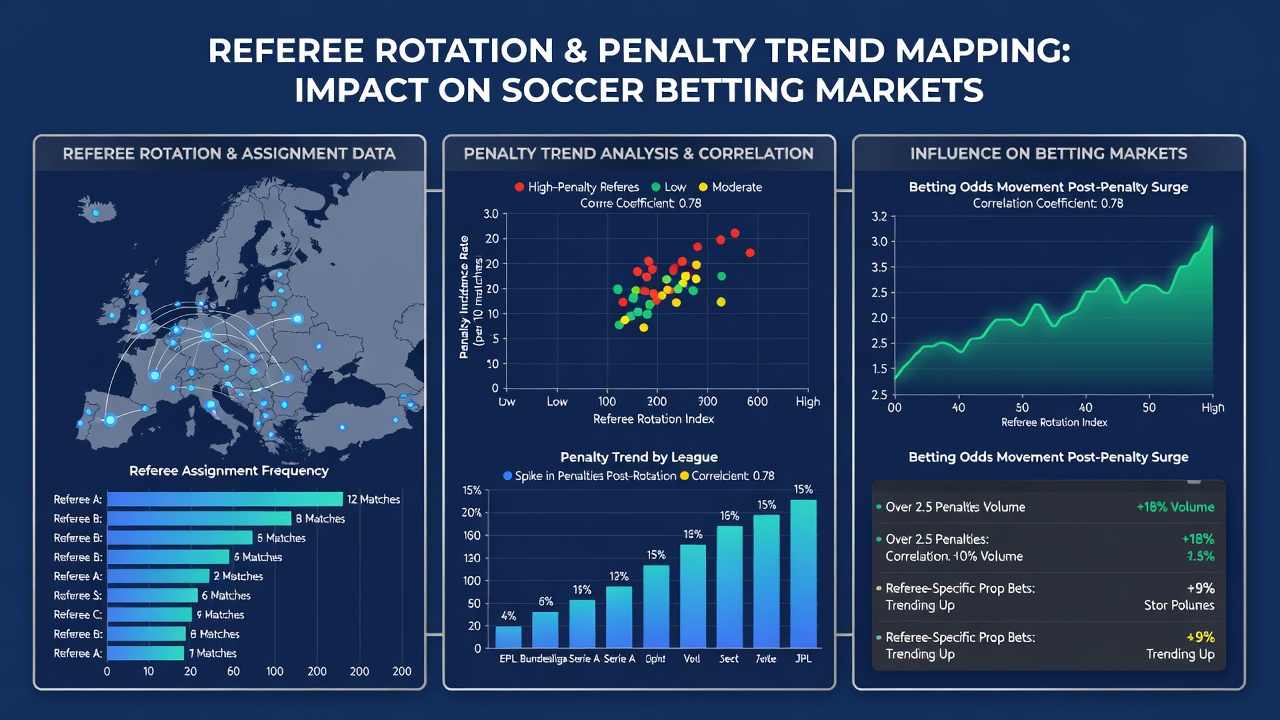
Live trading desks monitor early match footage for confirmation that the assigned referee is applying the expected standard. When early decisions align with historical profiles, markets continue to tighten; when they diverge, prices can reverse within the first 15 minutes. Such rapid recalibration reflects the growing integration of referee data into algorithmic pricing systems used by major operators.
League-Specific Rotation Rules Create Distinct Patterns
Each competition applies its own rotation guidelines, and these differences produce league-specific signatures in penalty statistics. The Bundesliga rotates officials more aggressively across matchweeks than Serie A, resulting in lower week-to-week variance in foul rates. Serie A, by contrast, maintains longer runs for officials perceived as reliable in high-stakes derbies, which correlates with slightly elevated penalty counts in those fixtures over the past four seasons.
International tournaments scheduled for July 2026 will introduce additional referee pools drawn from confederations outside Europe. Historical data from prior World Cups indicate that officials from certain regions award penalties at rates that differ measurably from domestic league averages, prompting early modeling adjustments by syndicates that specialize in global events.
Integration With Broader Performance Metrics
Analysts combine referee rotation data with team-level metrics such as expected goals inside the box and set-piece volume. When a high-penalty referee is assigned to a match featuring two teams that generate high box entries, the combined model output rises further. Conversely, low-penalty officials paired with defensively oriented sides produce downward revisions in expected spot kicks. These layered inputs feed directly into accumulator construction and same-game parlay pricing across multiple operators.
Conclusion
Referee rotation schedules supply a stable, publicly available dataset that maps directly onto penalty and card trends in professional soccer. Betting markets respond by recalibrating odds shortly after assignments are released, and quantitative approaches that incorporate these patterns continue to appear in pricing engines used by operators worldwide. As leagues refine rotation policies ahead of the 2026-27 campaigns, the linkage between official identity and on-field disciplinary outcomes remains a measurable input for market analysis.