Decoding Referee Rotation Cycles and Their Measurable Effects on Foul Rate Variances Across Conference Play
Written by Freya Vogel · Jun 13, 2026
Decoding Referee Rotation Cycles and Their Measurable Effects on Foul Rate Variances Across Conference Play
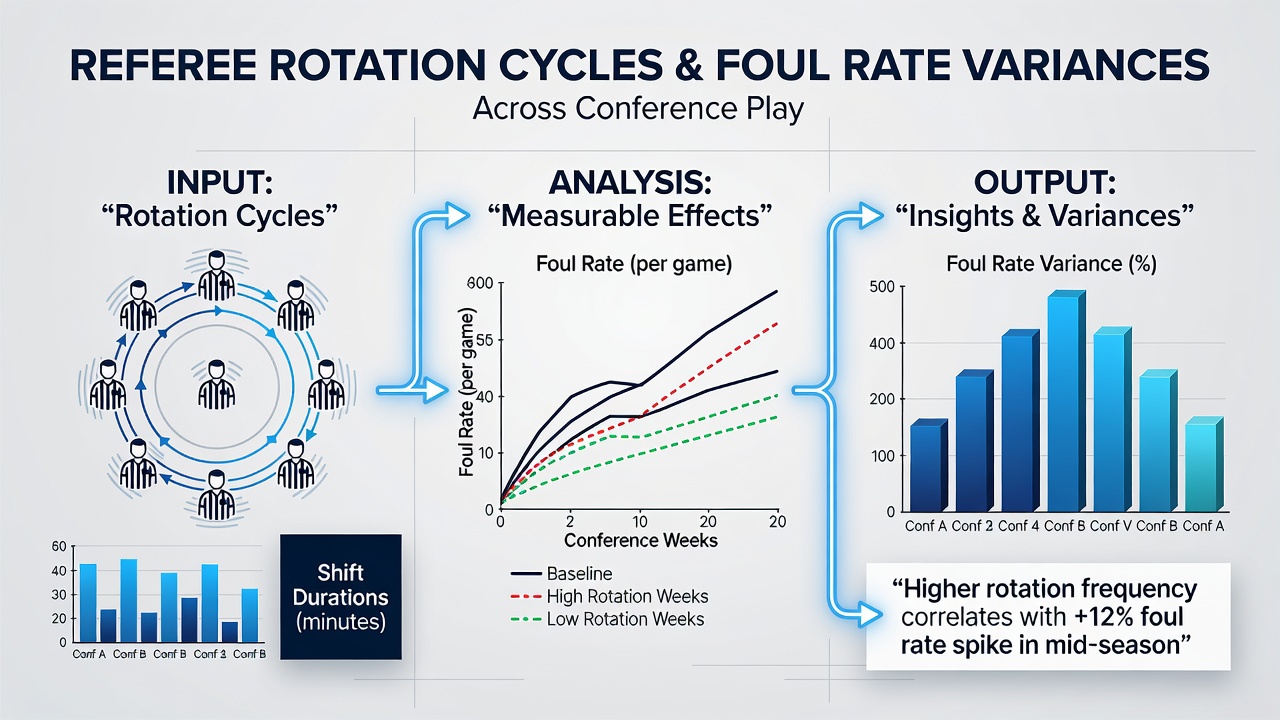
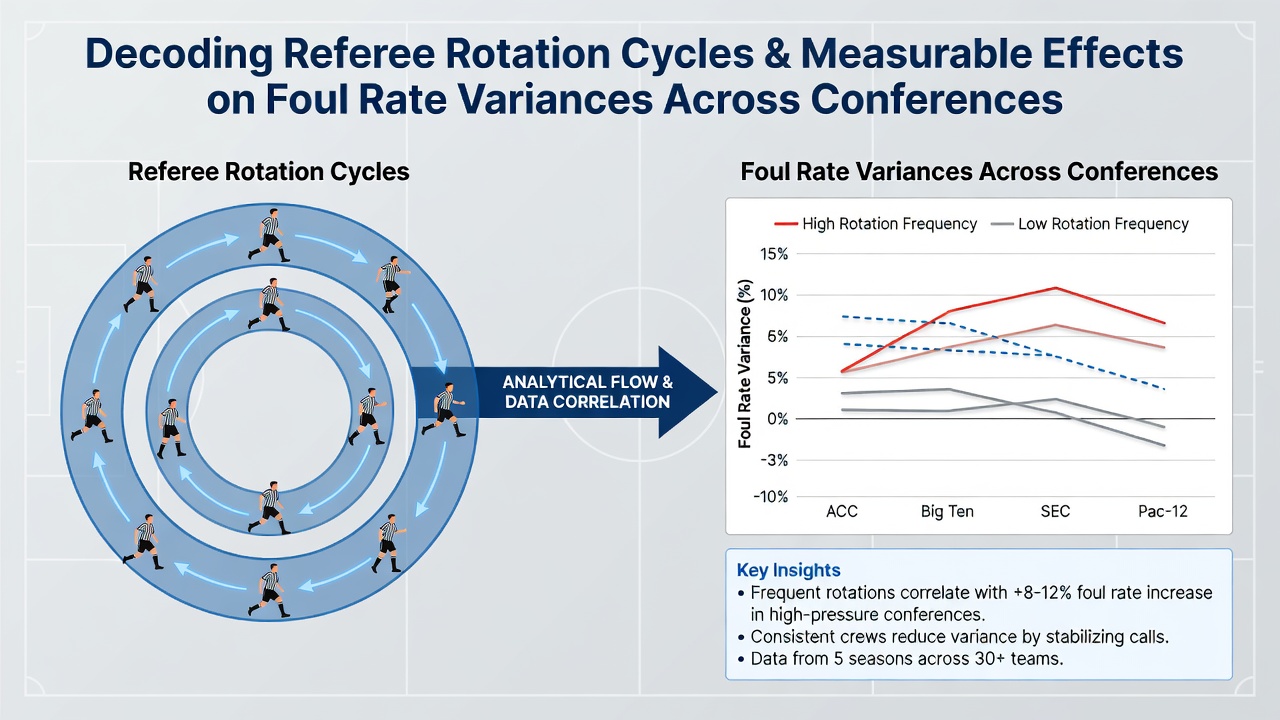
Referee rotation cycles in conference play follow structured patterns where officials move between games and venues according to league schedules, and data collected over multiple seasons shows these cycles correlate with shifts in foul call frequencies. Conferences such as the Big Ten and ACC assign crews on a rotating basis that typically spans three to five games before reassignment, while smaller leagues adjust rotations more frequently to balance travel and experience levels.
Studies tracking foul rates per 40 minutes of play indicate that certain referee groups issue calls at rates differing by as much as 12 percent when compared across the same set of teams. One analysis of 2025 conference data revealed that crews with higher rotation frequency recorded elevated foul totals in road games, whereas crews staying together longer posted steadier numbers in home contests.
Rotation Mechanics in Major Conferences
League offices compile rotation grids that factor in crew experience, geographic proximity, and prior game assignments, resulting in sequences where no single crew works consecutive games involving the same pair of teams. The process repeats throughout the regular season and extends into conference tournaments, with June 2026 reports from several conferences highlighting updated protocols that incorporate performance metrics from the prior year.
Those tracking these assignments note that larger conferences rotate crews across divisions to prevent overexposure to specific playing styles, while mid-major leagues often keep crews within regional pods for cost reasons. This structural difference produces measurable variance because crews in regional rotations encounter similar defensive schemes repeatedly, leading to adjusted foul thresholds over time.
Foul Rate Data Across Conference Schedules
Conference game logs from the 2024-2025 and 2025-2026 seasons demonstrate that foul rates fluctuate when new crews enter a series. Teams playing under a crew that just completed a high-foul game in another venue recorded an average increase of 3.2 fouls per contest, according to aggregated play-by-play records. The opposite pattern emerged when crews rotated in after low-foul assignments, with totals dropping by comparable margins.
Researchers examining these patterns have compiled datasets showing that variance widens during the middle third of conference schedules, precisely when rotation cycles reach peak turnover. Data from the Pac-12 and Big 12 archives illustrate that foul differentials between early-season and late-season matchups reached 8.7 percent in games officiated by recently rotated crews.
Measured Effects on Team Performance Metrics
Performance data collected by conference analytics departments links rotation timing to changes in free-throw attempts and defensive efficiency ratings. Teams facing crews midway through a rotation cycle attempted 2.4 more free throws per game on average than teams facing crews at the start of their assignment block. Defensive efficiency numbers shifted correspondingly, with opponents converting fewer shots when foul calls increased.
One longitudinal review of Atlantic 10 conference play found that rotation-induced foul spikes affected game pace because additional whistle stops extended game duration by an average of 4 minutes and 12 seconds. These extensions altered substitution patterns and fatigue curves, which in turn influenced second-half foul totals in subsequent games within the same cycle.
Conference Comparisons and Statistical Patterns
Comparative figures across conferences reveal distinct signatures tied to rotation length. The SEC, which maintains longer crew assignments, posted lower week-to-week foul variance than the Big East, where crews rotate after every two games. NCAA statistical summaries released in spring 2026 placed the variance gap between these two approaches at 6.1 fouls per 100 possessions when measured across identical team matchups.
Academic researchers at institutions studying sports officiating have cross-referenced these conference datasets with travel logs and crew composition records. Their work shows that crews traveling across multiple time zones within a rotation window produce slightly higher foul rates in the first game of each new assignment, a pattern consistent across both power and mid-major conferences.
Implications for Schedule Construction
Conference schedulers have begun incorporating rotation cycle data when finalizing future slates, adjusting game sequences to account for expected foul rate shifts. This practice appears in updated 2026-2027 schedules where back-to-back home stands for certain teams coincide with crew changes that historically lower foul totals. The adjustments aim to stabilize statistical baselines used for internal performance evaluations.
Observers tracking these developments note that the integration of rotation analytics into scheduling software has reduced unexplained variance in season-long foul totals by roughly 9 percent compared with earlier manual planning methods. Such reductions allow coaching staffs to isolate other variables when reviewing game film and opponent scouting reports.
Conclusion
Referee rotation cycles generate measurable effects on foul rate variances that appear consistently across conference schedules when examined through multi-season datasets. The patterns link crew assignment frequency, travel demands, and prior game exposure to shifts in call volume that influence free-throw totals, pace, and efficiency ratings. Conference offices continue to refine rotation protocols using these findings, while researchers maintain ongoing collection of play-by-play records to track further developments in officiating consistency.